
How to Tell if a Photo Is AI on Your iPhone
iOS 27.2 hides a SynthID watermark in AI images and edits. Learn how to check any photo from your iPhone, what results mean and when a clean result misleads.
Someone sends you a photo that looks a little too perfect, and you want to know if AI made it. Your iPhone can’t tell you on its own, but you can check it in about a minute with a free website. The short answer: upload the image to Google’s SynthID Detector at synthid.com. This guide explains how to do that from your iPhone, which images carry the watermark since iOS 27.2, and why a “no watermark” result never proves a photo is real.
Before you start: this guide reflects iOS 27.2 and the Apple and Google help pages as of October 2026. Both companies are still rolling this out, so button names and detector results may change. You don’t need iOS 27.2 to check a photo, because the detector runs in a web browser.
What changed in iOS 27.2
SynthID is an invisible watermark created by Google. Apple announced in June that it would adopt the technology, and it went live with iOS 27.2 on October 26, 2026. Apple’s iPhone User Guide says that in iOS 27.2 or later, “most images created or edited with Apple Intelligence tools” include the hidden watermark, and that you can use SynthID Detector to look for it.
Note the word “most.” Apple doesn’t promise every AI edit gets marked, and that matters when you read the results.
Google says the mark doesn’t reduce image quality and is designed to withstand cropping, filters and lossy compression. MacRumors reports that it’s stored in the pixels rather than in the file’s metadata. Apple doesn’t describe any option to turn it off.
Which iPhone images carry the watermark
| How the image was made | Watermark? | Source |
|---|---|---|
| Created in Image Playground | Yes, according to MacRumors | Apple says “most” images overall |
| Edited with Extend in Photos | Yes, in MacRumors’ testing | Hands-on test |
| Edited with Reframe in Photos | Yes, in MacRumors’ testing | Hands-on test |
| Large edit with Clean Up | Yes, in MacRumors’ testing | Hands-on test |
| Small edit with Clean Up | No, in MacRumors’ testing | Hands-on test |
| Regular camera photo, no AI edits | Not expected | Apple only describes marking generative tools |
Apple hasn’t published a tool-by-tool list, so treat the rows based on testing as a useful guide, not a guarantee. If you want to learn these editing tools, see our guide to Clean Up, Extend and Reframe in iOS 27.
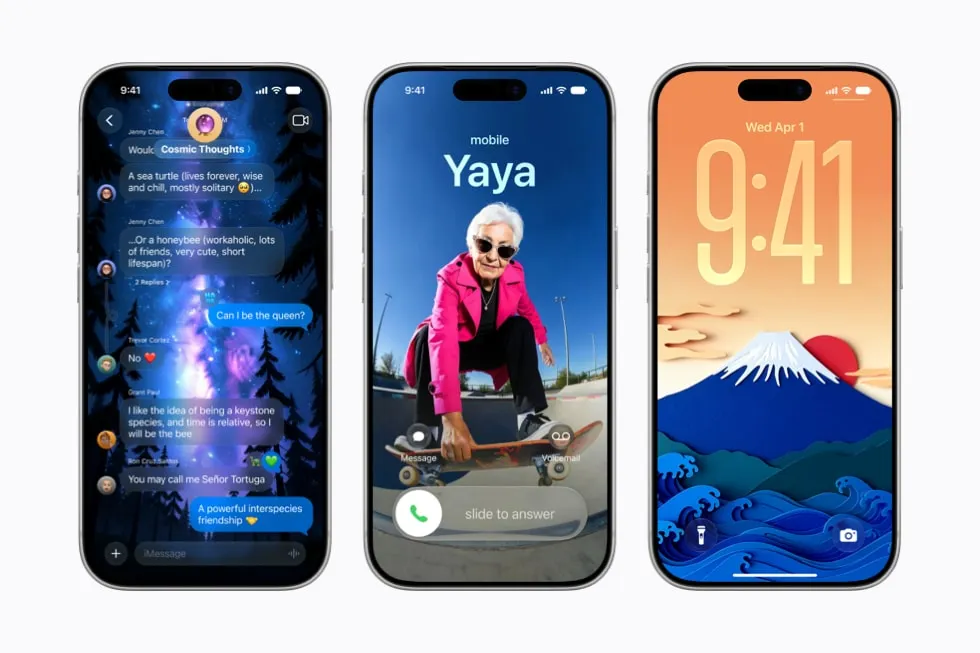
Image: Apple
How to check a photo with SynthID Detector
This is the method to start with for images that may have come from an iPhone. Google says its public detector looks for watermarks from Google and from partners, and it names OpenAI, NVIDIA, Kakao and Apple. It’s open to everyone worldwide, in English only for now.
- Save the image to your iPhone. In Messages, touch and hold the photo and choose the save option. In Safari, touch and hold the image and save it to Photos.
- Open Safari and go to synthid.com.
- Upload the image when the site asks for a file, choosing it from your photo library.
- Wait for the analysis and read the result.
Keep in mind that the file leaves your phone and goes to Google. Avoid uploading private photos, documents or pictures of children unless you’re comfortable with that.
A detail to watch: Google’s sources don’t fully agree yet. Its October announcement lists Apple as a partner, while its DeepMind page says Apple support is coming “soon.” If a photo you know was edited with Extend comes back without a mark, that may be why.
How to check a photo in the Gemini app
Gemini is a good second option, especially for images that may have come from Google’s own AI tools. Google’s help page gives these steps for iPhone:
- Open the Gemini app or go to gemini.google.com and sign in.
- Tap the Add files icon and choose Photos or Files.
- Pick one image and ask, “Is this AI-generated?”
The rules are simple: you must be signed in, you can upload one file at a time up to 100 MB, and you get about 10 image checks in any 24-hour period. If you’re checking a screenshot, crop it tightly around the image, and don’t upload collages.
The important limit is this: Google’s help page says Gemini can only recognize content from Google AI. So a “no” from Gemini tells you nothing about an image made with Apple’s tools. For those, use synthid.com.
You can also ask “Is this AI generated?” through Google Lens and AI Mode in Search, which check for the same Google watermark.
What the result really means
This is where most people get it wrong. The two outcomes aren’t equally strong.
| Result | What you can conclude | What you can’t conclude |
|---|---|---|
| Watermark found | All or part of the image was made or edited with a supported AI tool | That the whole image is fake (it could be a real photo with one edit) |
| No watermark | No supported watermark was detected | That the photo is real or untouched |
| Unclear | The detector couldn’t decide. Gemini may cite a reason, such as “Likely too small an edit” | Anything firm in either direction |
A clean result can happen for many ordinary reasons. The image may come from an AI tool that doesn’t use SynthID. It may have been made before the watermark existed, since Apple’s statement only covers iOS 27.2 or later. Or it may be a small Clean Up edit that never got marked.
So use the watermark as one clue. A positive result is strong evidence. A negative result is simply no evidence.
Other ways to investigate a suspicious image
When the detector finds nothing, these checks can fill in the picture:
- Look for the original. Run a reverse image search with Google Lens. Finding an older copy from a trusted source tells you more than any watermark. Google suggests this step too.
- Check the info panel on your own photos. Open the photo in Photos and swipe up or tap the Info button. Since iOS 18.1, 9to5Mac has reported that images edited with Clean Up show a “Modified with Clean Up” note here. The wording may differ on your version, and this label may not survive when a photo gets shared to other apps.
- Look at the source. Who posted it first? Does a reputable outlet carry the same image? Is the account asking you to send money or click a link? For scams, that context matters more than the pixels.
How to prove your own photo is real
Watermarks flag AI, but they can’t prove a photo is genuine. For that, Apple offers a separate feature called Apple Reference Image, available for capture on iPhone 18 Pro and iPhone 18 Pro Max only. It captures signed data from the Main camera sensor, a sort of digital negative that you can compare with the regular photo.
To set it up:
- Go to Settings > Camera > Reference Image.
- Tap Add Reference Mode and follow the instructions.
- Open Camera, swipe to Reference mode and take the photo.
- In Photos, open the picture and tap the Reference badge in the top-left corner to develop it. You’ll need an internet connection.
After that, tapping the image switches between the reference image and your photo, and Apple says crops, color changes and generative AI adjustments will be visible in the comparison. Anyone with iOS 27, iPadOS 27 or macOS 27 can view a shared reference image. Expect it to look flatter than the photo, since it has minimal processing.
There are trade-offs. Reference mode is off by default, some features such as Night mode don’t work in it, and each photo takes extra storage (about 8 to 10 MB before developing at 12 or 24 MP). Apple also warns that sharing a Reference photo before you develop it may reveal sensitive details, such as your device’s serial number, and the full image frame regardless of your zoom. Develop it first.
Quick answers
Can my iPhone detect SynthID by itself? No. MacRumors reports there’s no built-in option in iOS 27.2, and Apple’s guide points you to SynthID Detector.
Does checking cost anything? Apple and Google don’t list a fee for either the detector or the Gemini check. Gemini does have the daily limit mentioned above.
Will people see a mark on the AI images I share? No. The watermark is invisible, but anyone can upload your image to the detector and find it. Keep that in mind for contests or work where AI edits must be disclosed.
Do I need an iPhone with Apple Intelligence to check a photo? No. Only creating and editing with those tools requires a compatible iPhone. The check itself happens on a website or in the Gemini app. If you’re not sure your model qualifies, our guide on why Siri AI isn’t showing up shows how to check it, since Siri AI needs the same iPhone 15 Pro or newer.
Our recommendation
Make synthid.com your first stop, and add Gemini only when you suspect Google’s tools. Trust a positive result, but never treat a clean one as proof that a photo is real. If the stakes are high, such as a viral news image or a request for money, search for the original source before you believe it or share it. And if you own an iPhone 18 Pro and need your photos to hold up, turn on Reference mode before it matters.
Sources
- Apple Support: Clean up, extend, and reframe photos on iPhone
- Apple Support: About iOS 27 Updates
- Apple Support: Use Apple Reference Image on iPhone 18 Pro or iPhone 18 Pro Max
- Apple Newsroom: Apple Intelligence brings powerful AI capabilities into everyday experiences
- Google: Google expands SynthID Detector for AI content
- Google DeepMind: SynthID
- Gemini Apps Help: Verify AI-generated images, videos and audio on iPhone and iPad
- Google: Making it easier to understand how content was created and edited
- MacRumors: iPhone AI Images and Edits Now Have a Hidden Watermark
- 9to5Mac: iOS 18.1 labels images edited with Clean Up